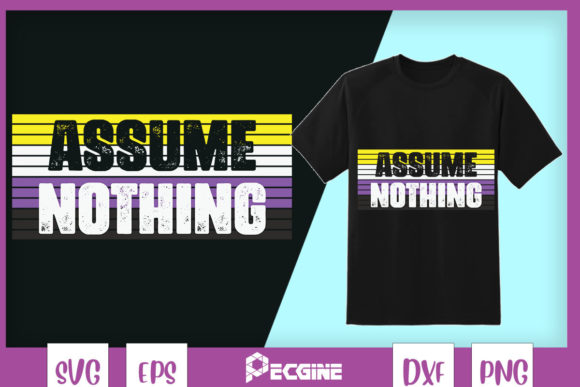
Assume Nothing Nonbinary Flag Barcode: Graphics for T-Shirt Designs
First Impression: Bold, Conceptual, and Culturally Anchored
When I opened Assume Nothing Nonbinary Flag Barcode for a client project—a seasonal capsule collection for a queer-owned handmade business—the immediate impression was one of intentional duality: structured yet expressive, minimalist in form but rich in meaning. It’s not just a barcode; it’s a reimagined symbol that embeds the nonbinary flag’s yellow, white, purple, and black stripes into the rhythmic vertical lines of a scannable format. That conceptual layer elevates it beyond decorative clipart—it reads as modern design with narrative weight. For brands prioritizing authenticity over trend-chasing, this graphic design asset lands with quiet confidence.
Fits Like a Signature Element—Not an Afterthought
We tested Assume Nothing Nonbinary Flag Barcode across real deliverables: product mockups for organic cotton tees, Instagram carousel banners, sticker sheets for packaging seals, and Canva templates for community event flyers. In each case, it functioned as a unifying visual motif—not competing with typography or photography, but reinforcing tone. On t-shirt designs, it worked especially well as a chest pocket accent or sleeve detail, where its rhythm echoes textile texture. As a sublimation design or printable design, its vector clarity held up flawlessly at 2” and 12” scales. For Cricut projects, the included DXF and SVG files imported cleanly, with crisp cut lines and no anchor-point drift.
Where It Shines: Contexts That Amplify Its Strength
- Hero graphics on landing pages or campaign banners—its high-contrast stripes command attention without shouting.
- Product mockups for print-on-demand platforms, especially when layered over neutral fabric textures or matte paper backgrounds.
- Supporting brand elements, like social media profile highlights, email newsletter dividers, or editorial design accents in zine layouts.
- Themed collections—we paired it with hand-drawn botanical line art and serif type for a “Pride & Press” stationery line, and it grounded the warmth with structural balance.
- Packaging details: printed subtly on tissue paper folds or embossed onto kraft tags, where its repetition feels intentional, not repetitive.
Where to Proceed with Intentional Editing
This isn’t a universal drop-in asset—and that’s a strength, not a limitation. Assume Nothing Nonbinary Flag Barcode can overwhelm small-scale applications (think favicon-sized icons or tiny QR-code labels), so avoid using it raw in tight UI spaces. It also loses legibility against busy or low-contrast backgrounds—test rigorously on both light and dark substrates before finalizing. For minimalist branding systems built around extreme whitespace or monochrome palettes, it may introduce visual tension unless balanced with ample negative space or tonal harmony. And while it adds emotional resonance for inclusive messaging, it shouldn’t replace clear, accessible language in professional corporate materials where neutrality is required.
Design Judgment in Action: What We Tested Before Client Approval
Before clearing Assume Nothing Nonbinary Flag Barcode for the client’s Etsy product launch, we ran six practical checks:
- Black-and-white conversion: Confirmed all four flag colors translate cleanly to grayscale values—no banding or value collapse.
- Contrast validation: Measured luminance contrast ratios on light/dark mockups; passed WCAG AA for medium text size.
- Scale responsiveness: Previewed at 16px (for web UI) and 3000px (for large-format posters)—no pixelation, no stroke distortion.
- File integrity: Verified SVG paths are editable, EPS opens in Illustrator without font dependencies, PNG has true alpha transparency.
- Type pairing tests: Set alongside Montserrat (sans), Playfair Display (serif), and a subtle handwritten script—each created distinct but cohesive moods.
- Licensing confirmation: Reviewed commercial license terms—yes, it permits use in client-facing digital products, physical merchandise, and marketing visuals without attribution.
Why It Earned a Spot in Our Design Bundle Rotation
In a landscape flooded with generic Pride-themed clipart, Assume Nothing Nonbinary Flag Barcode stands out because it respects both design craft and cultural context. It doesn’t shout—it invites recognition. It doesn’t decorate—it contextualizes. For creative marketplace sellers building themed design bundles, it’s a versatile anchor: pair it with coordinating pattern sets or use it solo as a statement SVG design. For bloggers and content creators, it adds visual credibility to posts about identity, inclusivity, or ethical branding. And for small business branding, it quietly signals alignment—not as performative allyship, but as embedded visual language.
A Final Note on Trust and Tone
Good design assets do more than look polished—they deepen audience connection. When a customer sees Assume Nothing Nonbinary Flag Barcode on a tote bag or website banner, they’re not just registering a symbol; they’re sensing intention. That trust transfers to the brand using it. So yes—it’s a t-shirt design, a graphics file, a printable design. But more importantly, it’s a thoughtful, commercially viable piece of visual storytelling. Use it where authenticity matters most, test it like you would any client-facing asset, and let its quiet precision do the speaking.