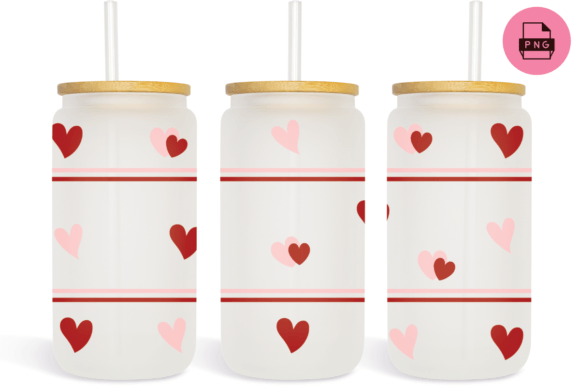
Mini Hearts Pattern Libbey Glass Can
A Sweet, Subtle Statement—Not Just Another Heart Design
When I first opened the Mini Hearts Pattern Libbey Glass Can file, I didn’t see clutter—I saw rhythm. Sixteen ounces of gentle repetition: tiny hearts aligned in a soft, horizontal band, sized and spaced to wrap naturally around the curve of a Libbey glass can tumbler. It’s not bold or brash; it’s quietly confident. That matters—especially when you’re stitching for a boutique baby gift line or prepping holiday merchandise for Etsy. This isn’t a design that shouts. It whispers “thoughtful,” “handmade,” “intentional.” And in today’s market, that whisper often converts better than the shout.
Real-World Fit: From Tea Towel to Tote Bag
Last week, I tested the Mini Hearts Pattern Libbey Glass Can on a natural linen tea towel—stitched as a narrow border along the bottom hem. The result? Crisp, clean, and instantly recognizable as handmade—not mass-printed. The heart scale (just under 0.5” tall at its widest point) held up beautifully in satin stitch, with no bleeding or distortion. I also ran it across the chest of a lightweight cotton sweatshirt using a medium-weight cutaway stabilizer. Because the pattern is linear and low-density—not a heavy fill or dense appliqué—it stitched quickly, cleanly, and stayed flat after washing. That’s huge for small shop owners who need reliability across batches.
This design thrives where subtlety sells: personalized nursery decor, embroidered kitchen linens, minimalist aprons for bakeries or coffee shops, and even as a repeating motif on patch-backed tote bags. As a machine embroidery design, it’s versatile enough for both beginner-friendly projects (think baby onesies with light stabilizing) and refined commercial embroidery—like branded staff aprons for a local café launching a Valentine’s pop-up.
Where Caution Meets Craftsmanship
That said, the Mini Hearts Pattern Libbey Glass Can isn’t magic—and pretending it is sets you up for frustration. Its strength lies in simplicity, but that also means it won’t carry visual weight on dark, napped, or heavily textured fabrics without thoughtful thread choice. On black terry cloth towels, for example, standard white poly thread disappeared unless I switched to a matte cream or pale blush for contrast. Always test thread colors on your actual fabric—not just on screen.
It’s also not built for ultra-small hoops. If you’re planning to embroider this onto a curved cap visor or a toddler-sized beanie, check whether the full repeat fits comfortably within your hoop’s active stitching area. The 9.75" width is generous for flat surfaces (towels, totes, pillow covers), but wraps tightly on cylindrical items like glass tumblers—so confirm alignment before final hooping. And while it’s labeled as a sublimation template, remember: as a digital embroidery file, it needs proper digitization for stitch execution. What ships is a high-res PNG—not an embroidery file. You’ll need to auto-digitize or manually convert it using software compatible with your machine.
Design Integrity in Action
What makes the Mini Hearts Pattern Libbey Glass Can feel professional isn’t just its symmetry—it’s how it supports brand consistency. When used across a product suite (e.g., matching embroidered tea towels, oven mitts, and aprons), it creates cohesion without monotony. Customers notice that. They trust it. A buyer who picks up your heart-embroidered kitchen towel is more likely to return for your holiday pillow covers—if the visual language feels intentional and polished.
For Etsy sellers and craft fair vendors, this pattern adds quiet value. It doesn’t scream “sale,” but it elevates perceived quality. Hand-stitched details get attention—but so does smart, consistent machine embroidery. And because it avoids fine lines, tight corners, or micro-lettering, it stitches reliably across machines—from Brother PE series to industrial Tajima setups—assuming proper stabilizer and tension calibration.
Practical Designer Notes Before You Stitch
- Always test first: Run the Mini Hearts Pattern Libbey Glass Can on scrap fabric that matches your final project’s weight, stretch, and texture.
- Stabilizer matters: Use tear-away for stable cottons, cutaway for knits or lightweight blends, and fusible + tear-away for nap-heavy fabrics like terry.
- Check density: Even simple patterns can overload thin fabrics. Zoom into your digitized version—look for overlapping satin columns or overly tight fill areas.
- Mock it in context: Drop the PNG into a printable mockup of your intended product (e.g., Libbey glass can, tote bag front, sweatshirt chest). Does it sit right? Does it breathe—or feel cramped?
- Verify licensing: This is a Graphics file—not an out-of-the-box embroidery file. Confirm whether your digitizing method and end use comply with the seller’s terms, especially for resale of finished products or digital embroidery files.
- Dark vs. light: Preview the design in grayscale on both black and white backgrounds. Does the heart shape retain clarity? Adjust contrast or stroke weight if needed before digitizing.
Final Thought: Less Is Anchored, Not Empty
The Mini Hearts Pattern Libbey Glass Can succeeds because it respects restraint. In a world flooded with oversized motifs and overworked embellishments, this pattern reminds us that rhythm, repetition, and proportion are powerful design tools—especially in embroidery. It won’t dominate a garment, but it will ground it. It won’t replace storytelling, but it will support it—on a baby blanket, a wedding favor towel, or a small shop’s signature tote bag.
As a Print Templates asset, it’s a starting point—not a finish line. Your skill in digitizing, stabilizing, and selecting thread transforms it from a PNG into a tactile experience. That’s where real value lives: not in the file itself, but in how thoughtfully you bring it to life. So download it, test it, refine it—and let those mini hearts do what they do best: add warmth, without weight.